Charlotte, North Carolina:
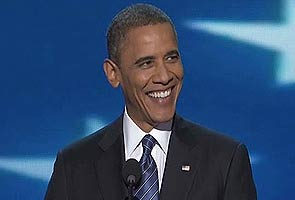
 His re-election in doubt, President
Barack Obama conceded only halting progress Thursday night toward fixing
the nation's stubborn economic woes, but vowed in a Democratic National
Convention finale, "Our problems can be solved, our challenges can be
met."
"Yes, our path is harder - but it leads to a better place,"
he declared in a prime-time speech to convention delegates and the
nation that blended resolve about the challenges ahead with stinging
criticism of Republican rival Mitt Romney's proposals to repair the
economy.
He acknowledged "my own failings" as he asked for a
second term, four years after taking office as the nation's first black
president.
"Four more years," delegates chanted over and over as the 51-year-old
Obama stepped to the podium, noticeably grayer than four years ago when
he was a history-making candidate for the White House.
The
president's speech was the final act of a pair of highly scripted
national political conventions in as many weeks, and the opening salvo
of a two-month drive toward Election Day that pits Obama against
Republican rival Romney. The contest is ever tighter for the White House
in a dreary season of economic struggle for millions.
Vice
President Joe Biden preceded Obama at the convention podium and
proclaimed, "America has turned the corner" after experiencing the worst
economic crisis since the Great Depression.
Obama didn't go that far in his own remarks, but he said firmly, "We are not going back, we are moving forward, America."
With
unemployment at 8.3 percent, the president said the task of recovering
from the economic disaster of 2008 is exceeded in American history only
by the challenge Franklin Delano Roosevelt faced when he took office in
1933.
"It will require common effort, shared responsibility and
the kind of bold persistent experimentation" that FDR employed, Obama
said.
In an appeal to independent voters who might be considering
a vote for Romney, he added that those who carry on Roosevelt's legacy
"should remember that not every problem can be remedied with another
government program or dictate from Washington.
He said, "The truth is, it will take more than a few years for us to solve challenges that have built up over the decades."
In
the run-up to Obama's speech, delegates erupted in tumultuous cheers
when former Arizona Rep. Gabrielle Giffords, grievously wounded in a
2011 assassination attempt, walked onstage to lead the Pledge of
Allegiance. The hall grew louder when she blew kisses to the crowd.
And
louder still when huge video screens inside the hall showed the face of
Osama bin Laden, the terrorist mastermind killed in a daring raid on
his Pakistani hideout by U.S. special operations forces" on a mission
approved by the current commander in chief.
The hall was filled
to capacity long before Obama stepped to the podium, and officials shut
off the entrances because of a fear of overcrowding for a speech that
the campaign had originally slated for the 74,000-seat football stadium
nearby. Aides said weather concerns prompted the move to the convention
arena, capacity 15,000 or so.
Obama's campaign said the president
would ask the country to rally around a "real achievable plan that will
create jobs, expand opportunity and ensure an economy built to last."
He added, "The truth is it will take more than a few years for us to solve challenges that have built up over a decade."
In
convention parlance, both Obama and Biden were delivering acceptance
speeches before delegates who nominated them for new terms in office.
But
the political significance went far beyond that - the moment when the
general election campaign begins in earnest even though Obama and Romney
have been pointing toward a Nov. 6 showdown for months.
To the cheers of delegates, Obama retraced his steps to halt the economic slide, including the auto bailout that Romney opposed.
"After
a decade of decline, this country created over a half million
manufacturing jobs in the last two and a half years," he said.
Turning to national security, he said he had promised to end the war in Iraq, and had done so.
"We've blunted the Taliban's momentum in Afghanistan, and in 2014 our longest war will be over," he said.
"A
new tower rises above the New York skyline, al-Qaida is on the path to
defeat and Osama bin Laden is dead," he declared, one of the night's
repeated references to the special operations forces raid that resulted
in the terrorist mastermind's demise more than a year ago.
He lampooned Romney's own economic proposals.
"Have
a surplus? Try a tax cut. Deficit too high? Try another. Feel a cold
coming on? Take two tax cuts, roll back some regulations and call us in
the morning," he said.
Mocking Romney for his overseas trip
earlier this summer, Obama said, "You might not be ready for diplomacy
with Beijing if you can't visit the Olympics without insulting our
closest ally." That was a reference to a verbal gaffe the former
Massachusetts governor committed while visiting London.
The hall
was filled to capacity long before Obama stepped to the podium, and
officials shut off the entrances because of a fear of overcrowding for a
speech that the campaign had originally slated for the 74,000-seat
football stadium nearby. Aides said weather concerns prompted the move
to the convention arena, capacity 15,000 or so.
Obama's campaign
said the president would ask the country to rally around a "real
achievable plan that will create jobs, expand opportunity and ensure an
economy built to last."
Biden told the convention in his own
speech that he had watched as Obama "made one gutsy decision after
another" to stop an economic free-fall after they took office in 2009.
Now,
he said, "we're on a mission to move this nation forward" from doubt
and downturn to promise and prosperity. ... America has turned the
corner."
Delegates who packed into their convention hall were
serenaded by singer James Taylor and rocked by R&B blues artist Mary
J. Blige as they awaited Obama's speech.
There was no end to the jabs aimed at Romney and the Republicans.
"Ask
Osama bin Laden if he's better off than four years ago," said
Massachusetts Sen. John Kerry, who lost the 2004 election in a close
contest with President George W. Bush. It was a mocking answer to the
Republicans' repeated question of whether Americans are better off than
when Obama took office.
The campaign focus was shifting quickly "
to politically sensitive monthly unemployment figures due out Friday
morning and the first presidential debate on Oct. 3 in Denver. Wall
Street hit a four-year high a few hours before Obama's speech after the
European Central Bank laid out a concrete plan to support the region's
struggling countries.
The economy is by far the dominant issue in
the campaign, and the differences between Obama and his challenger
could hardly be more pronounced.
Romney wants to extend all tax
cuts that are due to expire on Dec. 31 with an additional 20 percent
reduction in rates across the board, arguing that job growth would
result. He also favors deep cuts in domestic programs ranging from
education to parks, repeal of the health care legislation that Obama
pushed through Congress and landmark changes in Medicare, the program
that provides health care to seniors.
Obama wants to renew the
tax cuts except on incomes higher than $250,000, saying that
millionaires should contribute to an overall attack on federal deficits.
He also criticizes the spending cuts Romney advocates, saying they
would fall unfairly on the poor, lower-income college students and
others. He argues that Republicans would "end Medicare as we know it"
and saddle seniors with ever-rising costs.
After two weeks of back-to-back conventions, the impact on the race remained to be determined.
You're
not going to see big bounces in this election," said David Plouffe, a
senior White House adviser. "For the next 61 days, it's going to remain
tight as a tick."
Romney wrapped up several days of debate
rehearsals with close aides in Vermont and is expected to resume
full-time campaigning in the next day or two.
In a brief stop to
talk with veterans on Thursday, he defended his decision to omit mention
of the war in Afghanistan when he delivered his acceptance speech last
week at the Republican National Convention. He noted he had spoken to
the American Legion only one day before.
Romney's campaign released its first new television ad since the convention season began.
It
shows Clinton sharply questioning Obama's credibility on the Iraq War
in 2008, saying "Give me a break, this whole thing is the biggest fairy
tale I've ever seen." Obama was running against Hillary Rodham Clinton
at the time for the Democratic nomination.
It will likely be a
week or more before the two campaigns can fully digest post-convention
polls and adjust their strategies for the fall.
Based on the
volume of campaign appearances to date and the hundreds of millions of
dollars spent already on television advertising, the election appears
likely to be decided in a small number of battleground states. The list
includes New Hampshire, Virginia, Ohio, Colorado, Nevada and Iowa, as
well as Florida and North Carolina, the states where first Republicans
and then Democrats held their conventions. Those states hold 100
electoral votes among them, out of 270 needed to win the White House.
Money
has become an ever-present concern for the Democrats, an irony given
the overwhelming advantage Obama held over John McCain in the 2008
campaign.
This time, Romney is outpacing him, and independent
groups seeking the Republican's election are pouring tens of millions of
dollars into television advertising, far exceeding what Obama's
supporters can afford.
From: NDTV
 San Francisco: Google Inc rejected a request by the White House
on Friday to reconsider its decision to keep online a controversial
YouTube movie clip that has ignited anti-American protests in the Middle
East.
San Francisco: Google Inc rejected a request by the White House
on Friday to reconsider its decision to keep online a controversial
YouTube movie clip that has ignited anti-American protests in the Middle
East.