Baghdad: Iraq's fugitive Sunni vice president was sentenced
Sunday to death by hanging on charges he masterminded death squads
against rivals in a terror trial that has fueled sectarian tensions in
the country. Underscoring the instability, insurgents unleashed an
onslaught of bombings and shootings across Iraq, killing at least 92
people in one of the deadliest days this year.
It's unlikely that
the attacks in 13 cities were all timed to coincide with the afternoon
verdict that capped a monthslong case against Vice President Tariq
al-Hashemi, a longtime foe of Shiite Prime Minister Nouri al-Maliki.
Still, taken together, the violence and verdict could energize Sunni
insurgents bent on returning Iraq to the brink of civil war by targeting
Shiites and undermining the government.
Al-Hashemi fled to
Turkey in the months after the Shiite-led government accused him of
playing a role in 150 bombings, assassinations and other attacks from
2005 to 2011 - years in which the country was mired in retaliatory
sectarian violence that followed the 2003 U.S.-led invasion that ousted
Saddam Hussein's Sunni regime. Most of the attacks were allegedly
carried out by al-Hashemi's bodyguards and other employees, and largely
targeted government officials, security forces and Shiite pilgrims.

The vice president declined to immediately comment on the verdict after
meeting with the Turkish Foreign Minister Ahmet Davutoglu in Ankara. He
said he would "tackle this issue in a statement" in coming hours.
The
politically charged case - which was announced the day after U.S.
troops withdrew from the country last December - sparked a government
crisis and fueled Sunni Muslim and Kurdish resentment against al-Maliki,
whom critics say is monopolizing power.
Violence has ebbed
significantly, but insurgents continue to stage high-profile bombings
and shooting rampages. Al-Qaida's Iraq branch has promised a comeback in
predominantly Sunni areas from which it was routed by the U.S. and its
local allies after sectarian fighting peaked in 2007.
"These
attacks show al-Qaida's ability to hit any place in Iraq and at any
time," said Ali Salem, 40, an elementary school teacher in Baghdad. "The
lack of security could take us back to zero."
The worst violence
on Sunday struck the capital, where bombs pounded a half-dozen
neighborhoods - both Sunni and Shiite - thoughout the day. But the
deadliest attacks in Baghdad hit Shiite areas Sunday evening, hours
after the al-Hashemi verdict was announced. In all, 42 people were
killed in the capital and 120 wounded, according to police and hospital
officials who spoke on condition of anonymity because they were not
authorized to release the information.
The countrywide attacks
began before dawn, with gunmen killing soldiers at an army post in the
central Iraqi city of Dujail. A few hours later, a car exploded in a lot
where police recruits waiting in line to apply for jobs outside Kirkuk
in the country's north. Both Dujail and Kirkuk are former insurgent
strongholds.
Over the day, at least 92 people were killed and
more than 360 wounded in at least 21 separate bombings and shootings,
according to reports from police and hospital officials. No group
immediately claimed responsibility, but Iraq's Interior Ministry blamed
al-Qaida in Iraq.
"The attacks today on the markets and mosques
are aimed at provoking sectarian and political tensions," the ministry
said in a statement. "Our war against terrorism is continuing, and we
are ready."
The courtroom at Baghdad's criminal court was silent
Sunday as the presiding judge read out the verdict. It convicted
al-Hashemi and his son-in-law, Ahmed Qahtan, of organizing the murders
of a Shiite security official and a lawyer who had refused to help the
vice president's allies in terror cases. The two defendants were
acquitted in a third case of the killing of a security officer due to a
lack of evidence.
The court sentenced both men in absentia to
death by hanging. They have 30 days to appeal the verdict and could win a
retrial if they return to Iraq to face the charges. Al-Hashemi - who
has been in office since 2006 - is on Interpol's most-wanted list, but
Turkey has shown no interest in sending the vice president back to
Baghdad.
The defense team began its closing statement with a
searing indictment of Iraq's justice system, accusing it of showing no
independence and siding with the Shiite-led government.
"From the
beginning and through all procedures it has become obvious that the
Iraqi judicial system has been under political pressure," attorney
Muayad Obeid al-Ezzi, the head of the defense team, told the court.
The
presiding judge immediately interjected, warning that that the court
would open legal proceedings against the defense team if it continued to
heap accusations on the court or the legal system.
Reaction to the verdict was largely along sectarian lines on the streets of Baghdad.
Sunni lawyer Abdullah al-Azami called the trial "another farce to be added to the Iraqi judicial system."
Shiite
pharmacist Khalid Saied, meanwhile, said he supported the verdict and
hoped the government would broadcast all the evidence against al-Hashemi
"so that the entire world knows him."
Sunday's violence came
amid fears that the insurgency has gained new strength after suffering
heavy setbacks in U.S. and Iraqi offensives. Four of the attacks
targeted Kirkuk, where city police commander Brig. Gen. Sarhad Qadir
blamed the violence on al-Qaida.
The carnage stretched into the
country's south, where bombs stuck to two parked cars exploded in the
Shiite-dominated city of Nasiriyah, 320 kilometers (200 miles) southeast
of Baghdad. The blasts were near the French consulate and a local hotel
in the city, although the consulate did not appear to be a target of
the attack.
Local deputy health director Dr. Adnan al-Musharifawi
said two people were killed and three were wounded at the hotel, and
one Iraqi policeman was wounded at the consulate. Al-Musharifawi said no
French diplomats were among the casualties. In Paris, France's Foreign
Ministry said it "condemns with the greatest severity" the wave of
attacks.
A string of smaller attacks Sunday also struck nine
other cities. It was one of the worst outbreaks of violence in Iraq in
2012, although the single deadliest day was July 23, which saw at least
115 people killed - the most in more than two years.
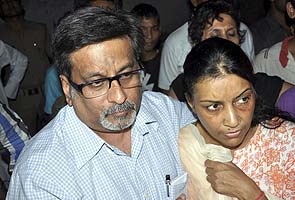 Ghaziabad: Nupur Talwar,
who left jail today after five months, and is charged along with her
husband with murdering their daughter and their domestic help said today
that "the truth will prevail."
Ghaziabad: Nupur Talwar,
who left jail today after five months, and is charged along with her
husband with murdering their daughter and their domestic help said today
that "the truth will prevail."