Showing posts with label Tamil Nadu. Show all posts

Thursday, September 27, 2012

Kudankulam protests: Police action unjustified, says report

Kudankulam protests: Police action unjustified, says reportChennai: Tamil Nadu police has been slammed by a fact-finding team that probed the handling of protests against the Kudankulam nuclear plant, specially calling its 'descration' of a church "dangerous and deplorable". The police has rejected the findings.

The team, led by former High Court judge Justice Kolse Patil has said that the use of force against the peaceful protesters was unjustified. Police had lathi-charged the protesters who wanted work on the nuclear plant to be stopped. The team also found that police, while trying to control the agitation, looted and damaged private and public property. The fact-finding team was formed after demands from the Chennai Solidarity Team for Kudankulam and Teachers Against Nuclear Energy.

In the most damning finding, the team said that the desecration of a church by the police was a "dangerous and deplorable act". There were allegations that police officers had barged into the St Lourde's church looking for protesters there. The Archbishop of Madras-Mylapore had alleged that the policemen "insulted religious symbols".

Justice Kolse Patil's team also said that charging the protesters with sedition and waging war against the state was irrational and that police action had created "fear psychosis" in the area.

Tamil Nadu Police though said that they had acted "responsibly" and had been attacked by villagers.

A protest against fuel loading in the nuclear power plant that had been going on for several days in Kudankulam was broken up by police after the Madras High Court gave its green signal to operationalise the plant. Police who had cordoned off the area around the plant had been taken by surprise after the protesters approached the plant by walking along the beach, leading to a stand-off. The protests are still continuing.

Thursday, September 20, 2012

Meeting over Cauvery dispute fails; Tamil Nadu will move Supreme Court, says Jayalalithaa

Meeting over Cauvery dispute fails; Tamil Nadu will move Supreme Court, says JayalalithaaNew Delhi: The meeting to discuss the long-standing water-sharing dispute over the Cauvery river has ended without a solution. Tamil Nadu Chief Minister J Jayalalithaa, whose state has been involved in a protracted legal battle with neigbouring Karnataka over the contentious issue, today described the outcome of the meeting as "disappointing".

The meeting of the Cauvery River Authority (CRA), the first in nine years, was attended by Prime Minister Manmohan Singh - who also heads the group - as well as the Chief Ministers of Tamil Nadu, Karnataka, Kerala and Puducherry. The session came after Ms Jayalalithaa demanded that a meeting of the CRA be convened to discuss the state's water problem while flagging the need for immediate release of water from the Cauvery to save standing crops. Karnataka, on the other hand, has refused to release water to Tamil Nadu, insisting on a new formula to share the water when monsoon fails.

Terming Prime Minister Manmohan Singh's advice to Karnataka to release 9,000 cusecs of water to her state as "unacceptable", Ms Jayalalithaa said "Tamil Nadiu is left with no option but to approach the Supreme Court...I have registered my protest against PM's award."

Tamil Nadu had earlier complained to the Supreme Court about non-convening of such a meeting prompting the top court to pull up officials of the Prime Minister's Office on September 3 for the inordinate delay. CRA, set up in 1997, met for the first time today after the Congress-led United Progressive Alliance (UPA) came to power in 2004. The last meeting was held in February, 2003 when AB Vajpayee was the Prime Minister.

Karnataka has refused to release water to Tamil Nadu and other riparian states on a formula announced by Cauvery River Tribunal in 2007 citing failed monsoon.

The dispute between Tamil Nadu and Karnataka over sharing of Cauvery water dates back to 1990s.

(With inputs from PTI)

Tuesday, September 11, 2012

Protests against Kudankulam nuclear plant intensify, one killed in police firing in Tuticorin: Latest developments

Kudankulam:  One person has reportedly died in police firing as protests against the Kudankulam Nuclear Power Plant in Tamil Nadu became more intense on a day that fuel was to be loaded in the first of two 1,000 megawatt reactors to enable it to start producing power. Demonstrators attempted to lay siege to the nuclear power plant, demanding a halt to the loading of enriched uranium in the reactor.Tamil Nadu Chief Minister J Jayalalithaa today assured protestors that the nuclear plant is safe and called for peace.

Here are the latest developments:
  1. One protester was reportedly killed when the police opened fire in Tuticorin district, which neighbours Kudankulam, after an agitation by fisherman in support of the Kudankulam protesters went out of hand. The situation is tense now.
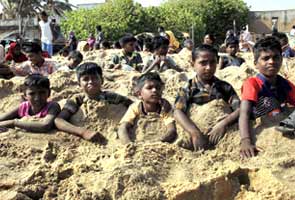
  2. In Kudankulam, protestors jumped into the sea when the police, caught by surprise when a 1000-strong demonstration used marched in using a different route, fired tear gas in an attempt to control the crowd.
  3. The tear gas was fired when the protesters were on the sea shore and just half a kilometre from the controversial plant which has been opposed by villagers and fishermen who remain unconvinced by assurances from experts and the government about security measures.
  4. Defying prohibitory orders, the protesters refused to disperse from the shores, despite repeated pleas by top police and district officials. Activists have cited the Fukushima disaster in Japan, triggered by a tsunami last year, to draw parallels about the dangers of a nuclear plant in this coastal part of India.
  5. The villagers and the police are now blaming each other for the violence. While the police says the villagers spread nets on seashore to trap them and attacked them with sticks, villagers accuse the police of deliberately creating a situation to target them.
  6. Reacting to the protests, Home Minister Sushil Kumar Shinde said today, "Foreign NGOs are supporting the Kudankulam protests.  Nuclear energy is clean energy." Back in February, the Prime Minister had also blamed foreign NGOs for inciting and funding the Kudankulam protests.
  7. So far, the village of Idinthakarai had served as the base camp and protest site for the activists and villagers. The villagers and activists want the government to immediately close the plant. The campaign has been led by SP Udhayakumar who heads the People's Movement Against Nuclear Energy. Mr Udhayakumar was warned yesterday that he would be arrested along with many others if he went ahead with today's rally. 5000 policemen have been posted around the plant.
  8. Commissioning the first unit at the atomic plant was cleared by a recent inspection conducted by the Atomic Energy Regulatory Board (AERB).
  9. After intense protests last year, Tamil Nadu Chief Minister J Jayalalithaa wrote to the PM to suspend all operations at the atomic project.  However, after experts said that the plant has world-class safety features, she did a u-turn and has since been demanding that all the power generated by Kudankulam must be made available for Tamil Nadu.
  10. During the peak of the protests, engineers and scientists had to be given police escorts to enter the Indo-Russian plant.

(With inputs from Agencies)

Tuesday, September 4, 2012

Sri Lankan government advises citizens not to travel to Tamil Nadu

New Delhi: The Sri Lankan government has advised its citizens not to travel to Tamil Nadu until further notice after Lankan pilgrims, visiting a church in Thanjavur in the state, were allegedly harassed. 184 pilgrims visiting the Poornimatha Church were allegedly mobbed and had taken refuge in the church. They will return to Sri Lanka.

"The Government of Sri Lanka regrets the increasing number of instances of intimidation of Sri Lankan nationals visiting Tamil Nadu for the purposes of tourism, religious pilgrimages, sporting and cultural activities and professional training," the Sri Lankan External Affairs Ministry said in a statement in Colombo.

"The Government of Sri Lanka is constrained to request Sri Lankan nationals in the interest of their security to desist from undertaking visits to Tamil Nadu until further notice," the statement said.

"In the event there is a compelling reason to visit Tamil Nadu, such a visit should take place following prior timely intimation to the Sri Lanka Deputy High Commission in Chennai," the statement added.

The advisory by the Sri Lankan government comes a day after Tamil Nadu Chief Minister J Jayalalithaa ordered that two Sri Lankan football teams which were undergoing training in Chennai be sent back.

Less than two weeks ago, Ms Jayalalithaa had asked Prime Minister Manmohan Singh to halt an ongoing training programme for two Sri Lankan defence personnel at the Defence Services Staff College in Wellington near Ooty.

In a strongly-worded letter, she had alleged that the training had been concealed from her government, which showed scant regard for the sentiments of the people of Tamil Nadu

Last month, the Chief Minister had also opposed a similar training programme for nine Sri Lankan Air Force personnel at the Tambaram Air Force Station in Chennai. In view of her stiff opposition and protests from other parties in the state including ally DMK, the Centre had been forced to move them to the Yelahanka Airforce Station in Bengaluru in order to enable them to complete their training. Ms Jayalalithaa had dubbed the move as "not proper", adding that "instead of sending these personnel back to Sri Lanka, the Government of India exhibited excessive enthusiasm and concern for these personnel".

Ms Jayalalithaa had then described it as "anti- Tamil" and said "Tamils want action against Sri Lanka for war crimes and they will not accept this" and that "Tamils even suspect whether the Centre is acting against them".

(With inputs from PTI)