Showing posts with label Nuke. Show all posts

Thursday, September 13, 2012

Kudankulam protesters to stand in sea today, taking cue from Khandwa 'jal satyagraha'

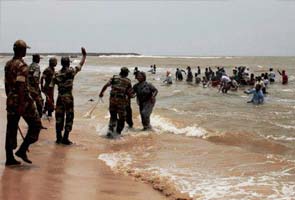
Kudankulam protesters to stand in sea today, taking cue from Khandwa 'jal satyagraha'Kudankulam: Taking a cue from  the 'Jal Satyagraha' activists in Madhya Pradesh, opponents of the Kudankulam Nuclear Power Plant will stand in the sea off Idianthakarai coast today as a stepped-up form of agitation.

Sources in People's Movement Against Nuclear Energy (PMANE), which is spearheading the stir, said the agitators have put forward four demands - stoppage of the process of fuel-loading in KNPP, giving up of the plan to arrest anti-nuclear movement leaders, adequate compensation for those who suffered losses and release of those already taken into custody.

The agitators yesterday ended their 48-hour relay fast at Idinthakarai to protest the police action which saw them resorting to lathicharge and bursting of teargas shells, besides conducting house-to-house searches.

Security forces had sealed almost the entire town housing the nuclear plant even as PMANE convenor S P Udayakumar remained elusive after a volte face on his surrender offer.

The forces allowed transportation of only essential commodities while clamping down on strangers.

The stepped-up security came as KNPP officials continued to make preparations for loading enriched uranium into the first reactor, expected to start in the next few days.

The current bout of intensified protests, including the failed bid to lay a siege to the plant, was launched by People's Movement Against Nuclear Energy to prevent loading of fuel for which regulatory authorities gave the approval recently.

On Sept 10, Madhya Pradesh government had agreed to the main demands of protesters who undertook a 'Jal Satyagraha' in Khandwa district, saying they would be given land as compensation and the height of Omkareshwar Dam would be reduced.

Both were key demands of the protesters who stood in neck- deep water since August 25 to agitate for proper rehabilitation and compensation.

From: NDTV

Tuesday, September 11, 2012

Protests against Kudankulam nuclear plant intensify, one killed in police firing in Tuticorin: Latest developments

Kudankulam:  One person has reportedly died in police firing as protests against the Kudankulam Nuclear Power Plant in Tamil Nadu became more intense on a day that fuel was to be loaded in the first of two 1,000 megawatt reactors to enable it to start producing power. Demonstrators attempted to lay siege to the nuclear power plant, demanding a halt to the loading of enriched uranium in the reactor.Tamil Nadu Chief Minister J Jayalalithaa today assured protestors that the nuclear plant is safe and called for peace.

Here are the latest developments:
  1. One protester was reportedly killed when the police opened fire in Tuticorin district, which neighbours Kudankulam, after an agitation by fisherman in support of the Kudankulam protesters went out of hand. The situation is tense now.
  2. In Kudankulam, protestors jumped into the sea when the police, caught by surprise when a 1000-strong demonstration used marched in using a different route, fired tear gas in an attempt to control the crowd.
  3. The tear gas was fired when the protesters were on the sea shore and just half a kilometre from the controversial plant which has been opposed by villagers and fishermen who remain unconvinced by assurances from experts and the government about security measures.
  4. Defying prohibitory orders, the protesters refused to disperse from the shores, despite repeated pleas by top police and district officials. Activists have cited the Fukushima disaster in Japan, triggered by a tsunami last year, to draw parallels about the dangers of a nuclear plant in this coastal part of India.
  5. The villagers and the police are now blaming each other for the violence. While the police says the villagers spread nets on seashore to trap them and attacked them with sticks, villagers accuse the police of deliberately creating a situation to target them.
  6. Reacting to the protests, Home Minister Sushil Kumar Shinde said today, "Foreign NGOs are supporting the Kudankulam protests.  Nuclear energy is clean energy." Back in February, the Prime Minister had also blamed foreign NGOs for inciting and funding the Kudankulam protests.
  7. So far, the village of Idinthakarai had served as the base camp and protest site for the activists and villagers. The villagers and activists want the government to immediately close the plant. The campaign has been led by SP Udhayakumar who heads the People's Movement Against Nuclear Energy. Mr Udhayakumar was warned yesterday that he would be arrested along with many others if he went ahead with today's rally. 5000 policemen have been posted around the plant.
  8. Commissioning the first unit at the atomic plant was cleared by a recent inspection conducted by the Atomic Energy Regulatory Board (AERB).
  9. After intense protests last year, Tamil Nadu Chief Minister J Jayalalithaa wrote to the PM to suspend all operations at the atomic project.  However, after experts said that the plant has world-class safety features, she did a u-turn and has since been demanding that all the power generated by Kudankulam must be made available for Tamil Nadu.
  10. During the peak of the protests, engineers and scientists had to be given police escorts to enter the Indo-Russian plant.

(With inputs from Agencies)

Thursday, August 30, 2012

Non-Aligned Movement (NAM) Summit opens today

Tehran: Amidst Western efforts to isolate Iran over its nuclear programme, the 16th Summit of the Non-Aligned Movement will open in Tehran on Thursday with issues like Syrian crisis and Palestine statehood set to dominate the agenda.

The Summit of the 120-nations grouping will open with Iran assuming the Chair from Egypt for the next three years.

Prime Minister Manmohan Singh is leading the Indian delegation to the two-day Summit which is being attended by over 30 Heads of State/Governments.

While the US has asked countries not to attend the NAM Summit due to its venue, Iran is projecting the presence of world's leaders as a big diplomatic win.

Asked about crucial issues, including Syria on which the members have differing views, government sources said: "We don't expect any fireworks on Syria... the attempt is to have a successful outcome of the Summit."

United Nations chief Ban Ki-moon also arrived in Tehran as an invited observer to the summit. The United States and Israel have criticised his presence in Iran.

Leaders already reported to have arrived in Tehran include Afghan President Hamid Karzai, Bangladesh Prime Minister Sheikh Hasina, Benin President Thomas Boni Yayi, Bhutanese Prime Minister Jigmi Thinley and Cambodian Prime Minister Hun Sen.

Iran is under four rounds of UN Security Council sanctions for turning down West's calls to give up its right of uranium enrichment.

Also, the US and its allies have imposed severe sanctions on Tehran hoping to force it to a negotiating table.

From: NDTV

Wednesday, August 22, 2012

Nukes protect India from blackmail by other powers: National security advisor

New Delhi: In a delicate balancing act, India today renewed its pitch for universal nuclear disarmament, but underlined that until the world arrived at "this happy state" it will continue to maintain atomic weapons as they have helped deter others from attempting nuclear coercion or blackmail. "On at least three occasions before 1998, other powers used the explicit or implicit threat of nuclear weapons to try and change India's behaviour," national security advisor Shivshankar Menon said at a national outreach conference on global nuclear disarmament.

Mr Menon disclosed that after India became a declared nuclear weapons state in 1998, it has not faced such threats.

"So the possession of nuclear weapons has, empirically speaking, deterred others from attempting nuclear coercion or blackmail against India," he added.

The day-long conference, organised by the Indian Council of World Affairs and supported by the external affairs ministry, saw the participation of nearly 1500 students from around 37 universities.

It was held to commemorate the 68th birth anniversary of former prime minister Rajiv Gandhi, who presented a plan for a nuclear-weapons-free world order at the UN General Assembly June 9, 1988.

In an oblique reference to Pakistan, Menon stressed that India has consistently maintained that its nuclear weapons were weapons of deterrence and not war-fighting weapons. "These weapons are for use against an attack on India."

"Unlike certain other nuclear weapon states, India's weapons were not meant to redress a military imbalance, or to compensate for some perceived inferiority in conventional military terms, or to serve some tactical or operational military need on the battlefield," he added.

Menon underlined that said the acquisition of nuclear weapons has imparted an added authority to India's moral authority for universal disarmament on the global fora.

"We spent 24 years after our first peaceful nuclear explosion in 1974 urging and working for universal nuclear disarmament and a nuclear free world," he said.

India argued for a nuclear weapons free world out of conviction that such a scenario would enhance national security and that of the rest of the world, he said.

"But sadly this was a conviction and view that obtained much lip sympathy and verbal support but was actually flouted in practice with increasing impunity by others," Mr Menon said.

"And when the division of the world into nuclear weapon haves and have-nots was sought to be made permanent in the nineties it became clear that possession of nuclear weapons was necessary if our attempts to promote a nuclear weapon free world were to be taken seriously and have some effect," he said. 

From NDTV