Showing posts with label Government. Show all posts

Thursday, September 27, 2012

Should all natural resources be auctioned? Supreme Court's answer today

Should all natural resources be auctioned? Supreme Court's answer todayNew Delhi: The Supreme Court will pronounce its opinion today on whether all natural resources must be auctioned by the government, a decision the court made earlier this year in the context of the expansive telecom scam.

In February this year, the court cancelled 122 telecom licenses issued by former minister A Raja in 2008 on the basis of a first-come-first-serve policy which he allegedly manipulated.  In its landmark judgement, the court said that a get-in-line policy was fundamentally flawed and that a competitive bidding process must be followed for allocating all national resources.

The government, however, has argued that is not always possible, and that the verdict impedes upon the executive's right to decide policy.  It sought a clarification from the Supreme Court on whether its stand on an auction, as expressed in the telecom or 2G verdict, applies to other national resources too.

The government has been recently indicted  by the national auditor or CAG who said that because coal blocks were not auctioned from 2004-2009,  the country lost upto 1.86 lakh crores.  Though the government has challenged that estimate, the auditor's conclusion has added to the debate over how resources should be given away to private firms.  In the case of both airwaves for telecoms and coal blocks, the government has argued that an auction would have led to increased costs which would have adversely impacted consumers and the industry.

From: NDTV

Saturday, September 15, 2012

Govt likely to announce spending cuts on Saturday

New Delhi: The government could announce spending cuts for the 2013 fiscal year on Saturday, although the size of the cuts was not immediately clear, two government sources said.

Prime Minister Manmohan Singh will chair a meeting of top government economists to discuss India's five-year economic strategy and look at trimming expenditure in the light of an economic slowdown.

"The government is quite serious to keep the fiscal deficit as close to budgeted target of 5.1 per cent of GDP as possible," one of the sources said.

A second source, a senior government official who did not want to be named, said the meeting would "discuss cuts for current spending".

Copyright: Thomson Reuters 2012

Govt clears FDI in multi-brand retail, 'furious' Mamata to decide on support on Tuesday

New Delhi: The government has cleared 51% Foreign Direct Investment or FDI for multi-brand retail, a major reform aimed at jumpstarting a lethargic economy and combating the image of an administration riddled with policy paralysis.

The move will allow global firms such as Wal-Mart Stores to set up shop with a local partner and sell directly to consumers for the first time, though individual states have the right to reject the reform. The proposal had been cleared by the cabinet in November last year but was suspended because of adamant opposition by key ally Mamata Banerjee, the chief minister of West Bengal. Her party warned today that it will take "a major decision on support" if the Congress does not withdraw both the FDI reforms cleared today and the decision yesterday to increase the prices of diesel by Rs. 5 and to cap the number of subsidised LPG cylinders available for each household. "We cannot support price hike of diesel and reduction in subsidized LPG cylinders. Today, a decision has been taken allowing FDI in retail sector. It is a big jolt," Ms Banerjee said on her Facebook page, adding that she was prepared to take "hard steps" if the new policies are not reversed.

The government appeared to have taken the risks into account. "We respect her decision...it is her prerogative to implement or not implement...equally it is the prerogative of other states to have it," said Commerce Minister Anand Sharma. The BJP and Left both described the multi-brand retail policy as a betrayal of the people, arguing that it will put thousands of small shop-owners and farmers out of business. 

The slew of reforms cleared by Dr Manmohan Singh today, the boldest in his current term, include permitting foreign airlines to buy upto 49% in an India carrier and selling off stake in major state-run firms, which will not be revoked, said sources. The government has also rejected demands from other political parties to revoke a hike in heavily subsidised fuel prices announced yesterday.

India's inability in the past months to push through major reforms and ease its subsidy burden as growth slowed sharply has put it in danger of becoming the first of the big "BRIC" emerging economies to see its credit rating downgraded to junk.

Foreign investors, experts, and industry have been stressing that the Prime Minister has a narrow political window to push reforms key to reviving India's flagging growth. The general elections are two years away, and international media in recent months has been critical of Dr Manmohan Singh, labelling him an "under-achiever" reluctant to take politically-tough but economically-critical decisions.

The government has been trying for months to build consensus around reforms in retail. Those plans appeared to come undone in June when Mulayam Singh Yadav, the head of the Samajwadi Party, wrote to the Prime Minister urging him not to proceed with reforming the retail sector because it would result in job losses.

Friday, September 14, 2012

Govt may allow foreign airlines to invest in aviation sector

New Delhi: Prime Minister Manmohan Singh, who has had to face some stinging criticism both at home and abroad for failing to push reforms that are crucial to revive a depressed economy, meets his ministers today to discuss norms to allow investment by foreign airlines in the aviation sector. This time the government hopes to get past its main hurdle, ally Trinamool Congress.

A Cabinet note - a copy of which has been accessed by NDTV - says that under the FDI proposal, foreign airlines will be allowed to invest in Indian peers, but can only hold up to a 49% stake. Although a 49 per cent stake gives the investors minority shareholder control, they will get the right to block a special resolution.

Current FDI norms allow foreign entities other than airlines to directly or indirectly own an equity stake of up to 49 per cent in Indian airlines.

The new proposal incorporates suggestions not just by the Aviation Ministry but also the Home Ministry, since this is a crucial sector with security implications.

The government, in its FDI in aviation proposal, has attempted to cover most areas of concern voiced by political parties. According to the Cabinet note, it is proposed that the chairman and two-thirds of the board of any domestic airline receiving FDI will need to be Indians, and substantial ownership and control will remain with Indian nationals.

Also, all foreign nationals participating in the venture will need security clearance. Equipment imports will have to be vetted by the aviation ministry.

Most of India’s airlines are bleeding and private airlines like Vijay Mallya’s Kingfisher have been pushing for FDI to boost the sector. But even if the Cabinet does clear the proposal, it has to get the Trinamool Congress’ ok on it.

The Trinamool has said its one Cabinet minister Mukul Roy will not attend today’s meeting – the excuse this time is President Pranab Mukherjee’s first visit to Kolkata. Mr Roy was also absent at a yesterday's meeting of the Cabinet Committee on Political Affairs, which was discussing, among other things, a hike in fuel prices.

Staying away from meetings is a classic indication of a Trinamool sulk, but the party usually follows it up with a letter seeking a deferment on the issue it is opposing. This time it has sent no such letter on FDI in aviation yet, and the government has its fingers crossed that it will not. It has also done its homework better this time and circulated its proposal among ministers yesterday.

The Cabinet note explains the rationale behind the move to allow foreign airlines to invest. The Indian aviation industry, it says, is steering through acute turbulence as most private airlines are in dire need of funds for operation. A denial of access to foreign capital could result in collapse of these airlines, and any airline’s closure could create a systemic risk for financial institutions, which have a large exposure to these companies.

The total FDI inflow in the aviation industry, the note says, stands at a mere $433.75 million (Rs 2,405.36 crore). FDI inflow into the aviation industry is a meager 0.25 per cent of the total FDI inflow.

A capital raise by these airlines is not easy as private equity funds are not keen to invest in the sector.

The Manmohan Singh government and the Prime Minister personally, have for some time now been facing severe criticism for allowing the economy to slide by not taking politically tough reform decisions.

Long feted for his pivotal role in liberalising the Indian economy, Dr Singh has recently received several less than flattering report cards from international publications like Time magazine and the Washington Post.

India has been downgraded by major overseas rating agencies and investment banks which have reiterated their concern about the “policy paralysis” afflicting the Indian government.

Back home a panicked Industry has been sending out SOS’ that the government must now place economic revival over coalition dynamics.

Ms Banerjee is the Congress’ most difficult ally; she has resisted most reform measures, arm-twisting the UPA government with the threat of exiting with her 19 crucial MPs in the Lok Sabha. Ms Banerjee is seen as having single-handedly given the UPA government its image of suffering a “policy paralysis”.

Analysts and overseas rating agencies have reiterated their concern about the policy paralysis afflicting the Indian government.

She has opposed FDI in various sectors like retail and aviation. She has forced the government to roll back fuel price hikes despite the deregulation of petrol. She has also stalled privatization of the pension sector.

Wednesday, September 12, 2012

Mulayam Singh Yadav's strong remarks against government, praise for Mamata

Mulayam Singh Yadav's strong remarks against government, praise for MamataKolkata: In a stinging critique of the UPA government, Mulayam Singh Yadav said his Samajwadi Party (SP) was in the opposition on Tuesday. He said that the SP was fulfilling the role the opposition by questioning the policies of the government, which he said had no direction.

The Samjawadi Pary supports the UPA government from outside and has bailed it out on several occasions, including the presidential elections recently and most importantly the confidence vote brought against the UPA-I government after the signing of the India-US nuclear deal and the Left's withdrawal of support.  "We are against their (UPA's) policies which they must correct. That is the role of the opposition and we are fulfilling it," he said in Kolkata.

"There is a huge challenge before the country... especially before us who in the opposition," he said.

The SP leader was speaking mostly about the coal scam that held up the entire monsoon session of Parliament and put the government on the mat.

"You can see there is no clear policy and we don't know where they want to take the country. No one can say. We sit everyday in the Lok Sabha.We listen. We are in touch with the govt, but there is no direction," he told reporters.

Mr Yadav  clearly distanced himself from the government on this issue. During the monsoon session, he had also organised a protest outside Parliament against the coal blocks allocation scam, along with the DMK and the Telugu Desam Party.

Not only will this open criticism and taking up the space of the opposition worry the Congress, so will the fact that all of this was happening in Mamata Banerjee's capital. Ms Bannerjee has been the toughest ally that the Congress has had to deal with and her positions often allied with those of the opposition.

Mr Yadav had several good things to say about Ms Banerjee, whom he called hard-working and a fighter, though also stubborn. This cosying up of the two leaders could also give the Congress heartburn over a possible third front emerging. In fact, Mulayam's brother and senior SP leader Ram Gopal Yadav said as much,"We pray that there's a third front."

The two were last seen together before the Presidential elections, where Mr Yadav first supported Ms Banerjee against Pranab Mukherjee's candidature and was then won over in a matter of 48 hours by the Congress. He was also given pride of place during the government's annual report card event at the Prime Minister's residence.

Samajwadi Party's 21 Lok Sabha MPs have also been seen by the Congress as a counter to the 19 that Ms Banerjee has, whenever it looked like she would pull out of government.

From: NDTV

Monday, September 10, 2012

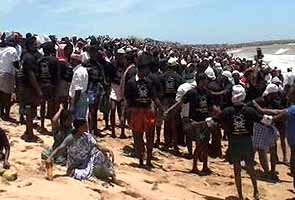
Kudankulam protests: Villagers hold huge rally amid tight security

Kudankulam protests: Villagers hold huge rally amid tight securityKudankulam: With enriched uranium fuel set to be loaded in the Kudankulam nuclear power plant in Tamil Nadu, protests against the controversial project were intensified again on Sunday. An uneasy calm prevailed at the nuclear plant with anti-nuclear protesters bracing for a showdown with authorities.

Villagers in and around the site of the plant held a rally yesterday to reiterate their demand of shutting down the controversial nuclear plant. Defying prohibitory orders, the protesters tried to lay siege to the plant and refused to pay heed to repeated appeals by authorities to disperse. Although police stopped them around half kilometre away from the plant, villagers continued to camp on the sea shore through the night.

The procession, the first outside the village of Idinthakarai in six months, is viewed as an attempt to lay siege to the plant, according to sources. With Pattali Makkal Katchi's (PMK) support to the rally, elaborate security arrangements were made with around 5000 policemen, including from the Rapid Action Force, were deployed around the plant.

Police said they will take action "as per the prevailing situation." The security authorities had also asked SP Udhayakumar, the face of the movement, to stay away from the rally.

However, over 1,000 anti-nuclear protesters led by Mr Udayakumar tried to march towards the plant but were prevented from proceeding by the Rapid Action Force personnel and police, half a kilometre from the site, police said.

Mr Udhayakumar is the coordinator of the People's Movement Against Nuclear Energy or PMANE, the banner under which the agitation is being carried out.

The fresh protests come in the wake of the country's nuclear watchdog, Atomic Energy Regulatory Board (AERB), having given its go-ahead on August 10 for loading of 163 enriched uranium fuel bundles in the first unit of the two 1,000 MW Russian reactors at the Kudankulam plant. After the reactor is fuelled, activities to approach first criticality-starting fission chain reaction, for the first time in a reactor, will be taken up. Then the power generation will be gradually scaled up on AERB's permission based on the results of various studies.

The project has been fiercely opposed by the locals and activists who have cited health and safety concerns arising out of the functioning of the nuclear plant. The agitation, which began last year, has pointed towards the nuclear disaster at the Fukushima plant in Japan last year that was triggered by a tsunami. The marathon sit-in protests and hunger strikes, which even saw the participation of children, had resulted in work being stopped at the plant.

Prime Minister Manmohan Singh had repeatedly allayed the fears of the locals with an expert committee constituted by the Centre having declared the project safe in January this year. The Tamil Nadu government, which initially sided with the locals and passed a resolution last year asking the Centre to halt work at the site, later gave its nod to the project in March this year. Chief Minister J Jayalalithaa had also announced Rs.500 crore for local area and infrastructural development.

The Madras High Court had, last month, greenlighted the commissioning of the plant.

But that has failed to convince the agitators who remain adamant on their position.

(With inputs from IANS, PTI)
Tuesday, September 4, 2012

Sri Lankan government advises citizens not to travel to Tamil Nadu

New Delhi: The Sri Lankan government has advised its citizens not to travel to Tamil Nadu until further notice after Lankan pilgrims, visiting a church in Thanjavur in the state, were allegedly harassed. 184 pilgrims visiting the Poornimatha Church were allegedly mobbed and had taken refuge in the church. They will return to Sri Lanka.

"The Government of Sri Lanka regrets the increasing number of instances of intimidation of Sri Lankan nationals visiting Tamil Nadu for the purposes of tourism, religious pilgrimages, sporting and cultural activities and professional training," the Sri Lankan External Affairs Ministry said in a statement in Colombo.

"The Government of Sri Lanka is constrained to request Sri Lankan nationals in the interest of their security to desist from undertaking visits to Tamil Nadu until further notice," the statement said.

"In the event there is a compelling reason to visit Tamil Nadu, such a visit should take place following prior timely intimation to the Sri Lanka Deputy High Commission in Chennai," the statement added.

The advisory by the Sri Lankan government comes a day after Tamil Nadu Chief Minister J Jayalalithaa ordered that two Sri Lankan football teams which were undergoing training in Chennai be sent back.

Less than two weeks ago, Ms Jayalalithaa had asked Prime Minister Manmohan Singh to halt an ongoing training programme for two Sri Lankan defence personnel at the Defence Services Staff College in Wellington near Ooty.

In a strongly-worded letter, she had alleged that the training had been concealed from her government, which showed scant regard for the sentiments of the people of Tamil Nadu

Last month, the Chief Minister had also opposed a similar training programme for nine Sri Lankan Air Force personnel at the Tambaram Air Force Station in Chennai. In view of her stiff opposition and protests from other parties in the state including ally DMK, the Centre had been forced to move them to the Yelahanka Airforce Station in Bengaluru in order to enable them to complete their training. Ms Jayalalithaa had dubbed the move as "not proper", adding that "instead of sending these personnel back to Sri Lanka, the Government of India exhibited excessive enthusiasm and concern for these personnel".

Ms Jayalalithaa had then described it as "anti- Tamil" and said "Tamils want action against Sri Lanka for war crimes and they will not accept this" and that "Tamils even suspect whether the Centre is acting against them".

(With inputs from PTI)